Update date: 2026-04-29
The Role of Biomolecular Condensates in Plant-Environment Interactions
Eukaryotic cells are physically compartmentalized to ensure the efficiency and efficacy of biochemical reactions and cellular functions. Biomolecular condensates, which lack a surrounding lipid membrane, represent a unique mode of compartmentalization. They offer broad advantages over membrane-bound organelles due to their ability to assemble and dissolve spontaneously and rapidly. In most cases, biomolecular condensates are assembled through liquid–liquid phase separation (LLPS) of proteins and/or RNAs. Within a eukaryotic cell, numerous biomolecular condensates are spatially and temporally localized.
Plants are unique in that they cannot move and must rapidly cope with continuous changes in light, temperature, water status, and other environmental factors. Owing to their reversibility, dynamics, and selectivity, biomolecular condensates are ideal stress sensors. Biomolecular condensation can modulate cellular activity through distinct mechanisms, including enhancing or inhibiting biochemical reactions, forming new protein-protein or protein-nucleic acid interaction networks, acting as buffers, and generating capillary forces. In this way, condensates not only sense stress but can also transduce stress signals to downstream processes.
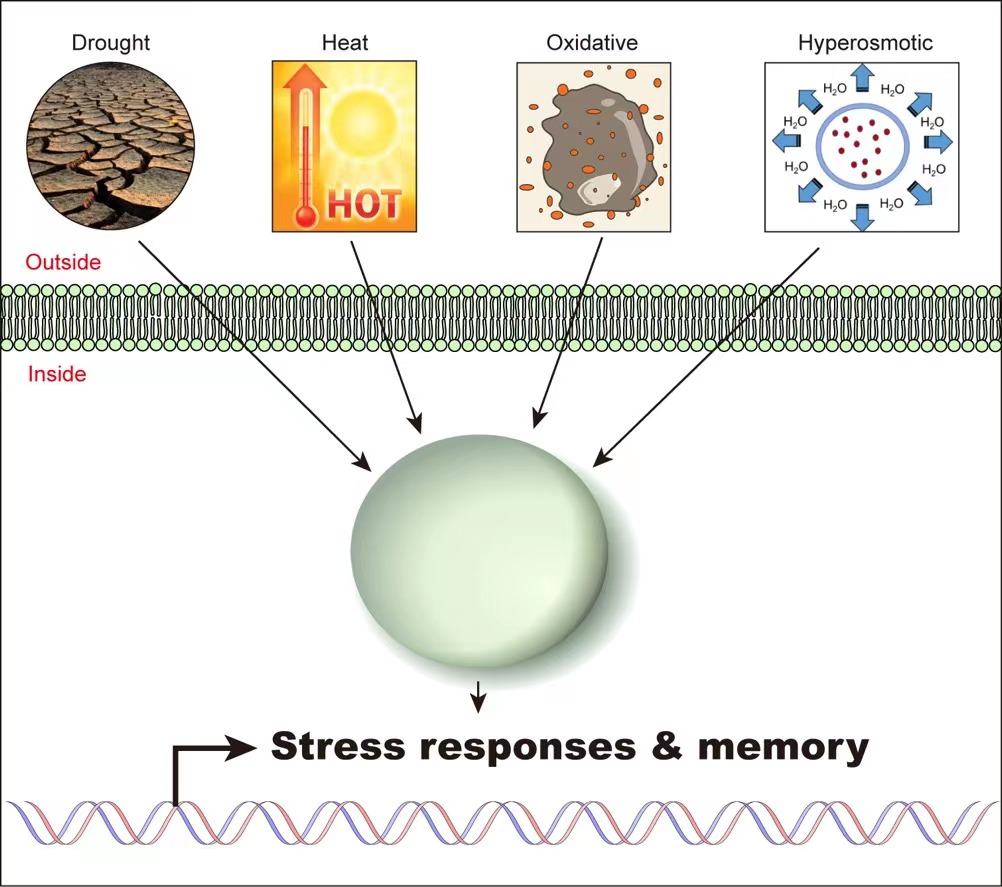
Our laboratory aims to uncover how plant cells employ biomolecular condensates to sense abiotic stresses—primarily heat, drought, and salt—and to adjust gene expression for adaptation. We further explore how changes in the material properties of condensates, from liquid to gel or solid states, influence cellular stress responses. Whereas liquid-like condensates are readily reversible upon stress relief, more solid-like assemblies can persist, potentially encoding molecular memory of previous stress events. Understanding these transitions provides insight into how plants achieve both rapid response and long-term adaptation to environmental challenges.